On this page
How to Build Technical Interviews That Work in the AI Era

- Allowing AI tools without redesigning the questions changes nothing; the format itself needs to shift toward multi-phase, judgment-based assessments.
- A good technical interview tests code comprehension and architectural decisions, since that's what engineers actually spend their time on, not algorithm recall.
- Unsupervised take-homes produce unreliable signal in an AI-assisted world, so live, collaborative formats are a better source of truth.
Your technical interview is testing the wrong thing. 75% of all new code at Google is now AI-generated and approved by engineers. On any given day, your engineers are using Copilot, Cursor, or Claude to write, debug, and review code. And your interview process is still asking candidates to write algorithms from memory in a blank editor with no tools.
You are not testing job performance. You are testing preparation for a format that does not exist in real work.
The technical interview has not kept up with how engineering actually works. 54% of developers cite lack of relevance to actual job roles as their top complaint about coding assessments. That signal gap has always existed. AI has widened it to the point where the cost of running the wrong process is now measurable in bad hires.
Check: AI Talent Sourcing Tool
How AI Is Changing Coding Interviews
The biggest companies have already moved. The question is whether your process will follow. Google is piloting AI-assisted coding interviews where candidates use Gemini during the assessment. Interviewers evaluate AI fluency: prompt engineering, output validation, and debugging skills. The format is described internally as "human-led, AI-assisted."
Meta replaced one of its two coding rounds with a 60-minute AI-assisted session in CoderPad. Candidates can use GPT, Claude, Gemini, or Llama. They are evaluated on problem solving, code quality, verification, and communication, not on whether they can recall a sorting algorithm without help.
Canva now expects backend, machine learning, and frontend engineering candidates to use AI tools like Copilot, Cursor, and Claude during technical interviews. They redesigned their questions to be more complex, more ambiguous, and more realistic, because the old format gave them no signal about skills that actually matter.
These are not experiments. They are responses to a fundamental shift in what engineering work looks like.
Suggested: How Can You Automate Interviewing Candidates
Why Traditional Technical Interviews Fail in 2026
They Test Preparation, Not Performance
A candidate who has spent three months grinding LeetCode problems will outperform a stronger engineer who has been shipping production systems and has not memorized algorithm patterns. That is not a hiring signal. That is a test of test preparation.
The most rehearsable performance in a coding interview is not the one that predicts job success.
Asynchronous Take-Home Assessments Are Broken
63% of US employers still use automated code tests and 45% still use take-home projects. Confidence in both is falling fast.
The reason is simple. Any take-home assessment can be completed with AI assistance, and there is no reliable way to detect it in the output. Prohibiting AI use in a take-home is not enforceable. It creates an incentive to cheat, not a fair evaluation of real capability.
Suggested: Top AI Recruitment & Hiring Software
They Ignore the Skills That Actually Matter
Canva found their traditional interviews gave them no signal about code reading, comprehension, or the ability to improve AI-generated code. Engineers spend most of their time understanding existing codebases, reviewing pull requests, and iterating on solutions, not writing algorithms from scratch.
A process that only tests the rarest part of the job is not a useful filter.
How to Redesign Technical Interviews for AI-Assisted Coding
The redesign is not simply "allow AI tools." Allowing AI while keeping the same questions and format changes nothing.
That means three things in practice.
Step 1: Redefine the Skills You Are Testing
Before redesigning the format, answer this question: what does success look like in the first six months of this role?
For most engineering roles in 2026, the answer involves reading existing codebases, making good architectural decisions under constraint, reviewing AI-generated code, and debugging systems that were not designed by the person debugging them.
Your interview should generate signal on those skills. Not on algorithm recall.
Suggested: How to Hire an AI Engineer in 2026
Step 2: Build Three-Phase AI-Assisted Assessments
The format that is emerging across forward-thinking companies follows a three-phase structure:
Phase 1: Problem decomposition
Present a complex, ambiguous requirement. The candidate breaks it into smaller tasks, asks clarifying questions, and communicates their reasoning. This phase tests analytical thinking, not code output.
Phase 2: AI-assisted implementation
The candidate uses their preferred AI tools to implement the solution. Interviewers observe how they prompt the AI, how they evaluate output, how they iterate, and whether they are directing the AI or accepting whatever it generates.
Phase 3: Code review and refinement
The candidate reviews the AI-generated output, identifies weaknesses, adds tests, and ensures the code meets production standards. This is where engineering judgment separates strong candidates from weak ones.
Suggested: How to Hire AI Engineers in a Competitive Market
Step 3: Retrain Interviewers to Evaluate Process, Not Output
The traditional interviewer role is to present a problem and score the output. In an AI-assisted format, the interviewer role shifts to observing how the candidate thinks: how they prompt, how they question AI outputs, how they communicate their reasoning.
Candidates who silently paste AI output without narrating their reasoning receive negative feedback across every company running these formats. The signal is in the process. Interviewers need to know how to read it.
Suggested: How to Add AI to Your Hiring Tech Stack
What to Test in an AI-Assisted Coding Interview
The skills that matter in 2026 are different from the skills that mattered in 2019.
AI fluency:
Can the candidate prompt effectively? Do they validate output? Do they recognize when AI is confidently wrong?
Code comprehension:
Can the candidate read and debug an existing codebase they did not write? This is the majority of real engineering work.
Engineering judgment:
Does the candidate know when to use AI for a subtask and when human reasoning is required? Do they take responsibility for the final output regardless of how it was generated?
Communication under constraint:
Can the candidate explain their reasoning while working? Do they flag trade-offs and constraints without being asked?
A strong AI-assisted coding interview tests all four. A weak one tests only whether the candidate can produce working code with assistance, which tells you almost nothing.
Suggested: Best AI Recruitment Platforms
AI Coding Interview Questions to Use
Replace algorithm recall questions with scenario-based problems that require genuine judgment even with AI assistance:
- Give the candidate a multi-file codebase with a real bug. Ask them to identify, explain, and fix it using any tools they choose. Observe the process.
- Present an ambiguous product requirement. Ask them to scope the implementation, identify what they would need to know before starting, and build the first component.
- Show them 50 lines of AI-generated code. Ask them to review it as if it came from a junior engineer on their team.
How Qureos Helps With Technical Hiring
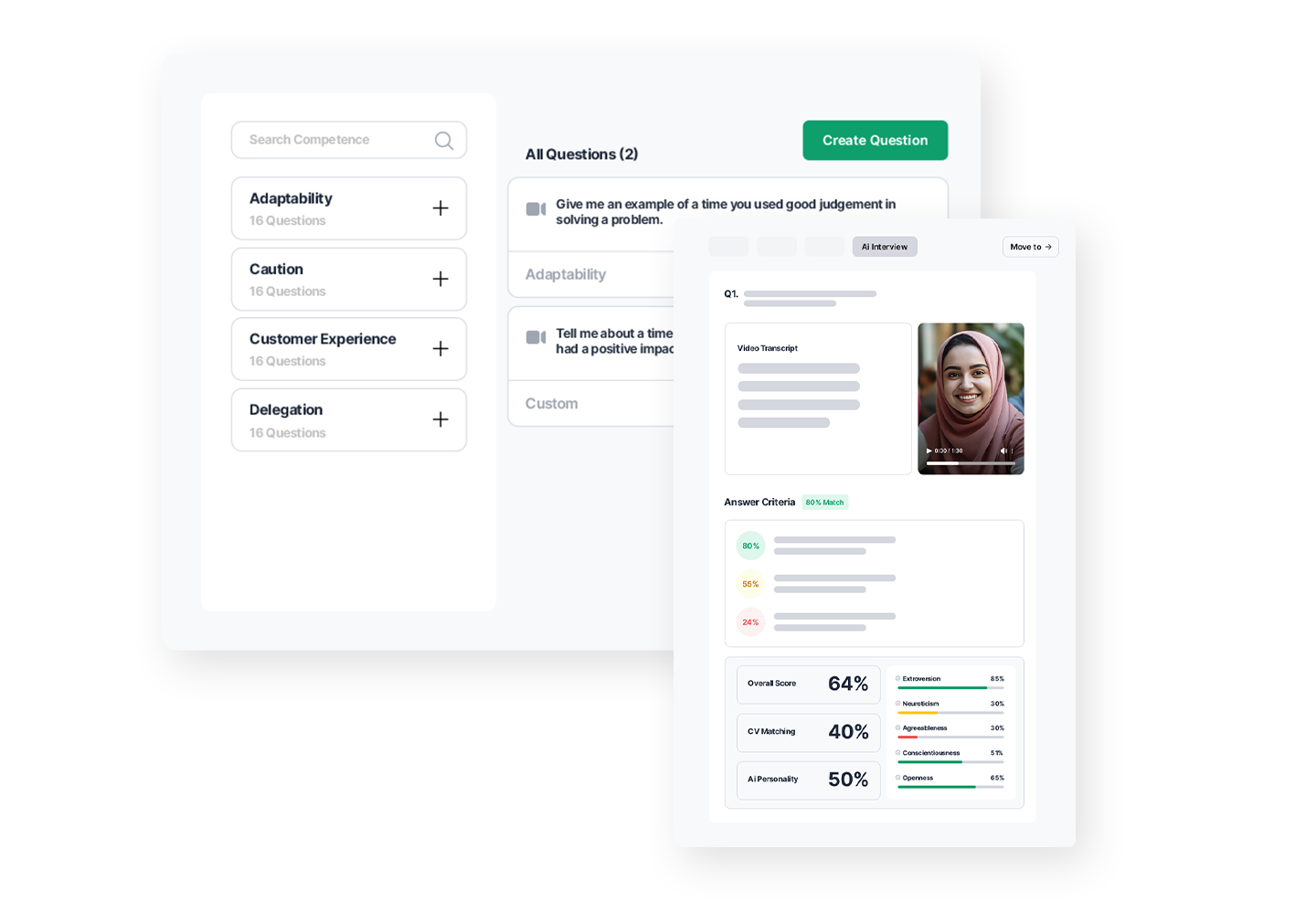
The judgment signals this redesign asks interviewers to catch, prompting precision, reasoning under constraint, ownership of output, are exactly what most panels score inconsistently. Qureos' AI interviews fix that: structured, role-specific questions scored against your rubric the same way every time.
The newly launched Personality Insights module goes deeper, assessing OCEAN traits like Conscientiousness and Openness directly from how a candidate communicates under pressure, not a bolted-on test. It tracks whether they stay structured under ambiguity or just accept the AI's first answer.
The result lands on the candidate's report: scores, supporting evidence, and a visual profile your panel can review in minutes.
FAQ
How is AI changing coding interviews?
Leading companies including Google, Meta, and Canva now allow or require AI tool use during technical interviews. The format has shifted from algorithm recall toward AI fluency assessment: how candidates prompt, validate output, review AI-generated code, and communicate their reasoning.
Should candidates use AI during technical interviews?
At companies running AI-assisted formats, yes. Candidates who avoid AI tools in these interviews score lower than those who use them strategically. The key is directing the AI rather than accepting its output, narrating reasoning throughout, and taking full responsibility for the final solution.
How do companies prevent AI cheating in interviews?
The answer is redesigning the questions, not restricting the tools. Questions that require genuine engineering judgment, code comprehension in existing systems, and constraint-based problem solving cannot be solved by AI alone. The process itself becomes the filter.
What are the best coding assessments for 2026?
Three-phase live assessments: problem decomposition, AI-assisted implementation, and code review. Multi-file codebase debugging exercises. Ambiguous product requirements scoped in real time. These formats generate signal that algorithm-based tests cannot.
How do you evaluate AI-assisted programmers?
Evaluate the process, not just the output. Strong candidates prompt with precision, question AI-generated code, narrate their reasoning, and take ownership of the final result. Weak candidates accept whatever the AI produces without validation.
Suggested: How to Screen a Candidate
Conclusion
The technical interview format most companies are running was designed for a world where engineers wrote every line of code from memory. That world does not exist anymore.
The companies getting this right are not fighting the AI reality. They are designing assessments that generate real signal in an AI-assisted environment: harder problems, live collaborative formats, and evaluation criteria built around judgment rather than output.
Every month you run an outdated interview process, you are optimizing for the wrong candidate.
.webp)